There is no single piece of UK legislation that says "you must have a spill kit." Instead, the requirement comes from several overlapping regulations that, taken together, make spill response equipment a practical necessity for almost any site that stores or handles liquids. This guide explains what the law actually requires and what that means in practice.
The Environmental Protection Act 1990
The Environmental Protection Act establishes the principle that businesses have a duty of care to prevent pollution. Under Section 34, anyone who produces, imports, keeps, stores, transports, treats, or disposes of waste has a responsibility to ensure it does not escape into the environment.
A spill that reaches a watercourse, drain, or land is a pollution incident. The Environment Agency (or SEPA in Scotland, NRW in Wales) can prosecute under this Act, and penalties are severe — unlimited fines and, in serious cases, imprisonment. Having appropriate spill response equipment is one of the key "reasonable measures" regulators expect to see.
COSHH Regulations 2002
The Control of Substances Hazardous to Health (COSHH) Regulations require employers to assess the risks from hazardous substances and implement controls. Regulation 7 specifically requires employers to ensure that exposure is prevented or adequately controlled.
For any substance covered by a COSHH assessment, you need to demonstrate that you have measures in place to deal with accidental releases. In practice, this means having the right type of spill kit — typically a chemical spill kit — positioned near where hazardous substances are stored or used, along with trained staff who know how to deploy it.
Oil Storage Regulations 2001
These regulations apply to any site storing more than 200 litres of oil (including diesel, engine oil, hydraulic fluid, and other petroleum products). They set specific requirements for containment — secondary containment must hold 110% of the largest container's volume or 25% of the total stored volume, whichever is greater.
While the regulations focus on fixed containment (bunds, drip trays), the Environment Agency's Pollution Prevention Guidelines (now withdrawn but still referenced as best practice) recommend spill kits as part of a layered approach. A bund catches the bulk of a spill, but a spill kit handles what escapes — splashes during transfer, small drips, and residual liquid after containment.
Who Is Responsible?
Responsibility sits with the site operator — in most cases, the business that occupies the premises. Under environmental law, the "polluter pays" principle applies. If a spill from your site contaminates land or water, your business bears the cost of remediation, regardless of whether you own the building.
In practice, responsibility for spill preparedness is typically delegated to facilities managers, health and safety officers, or environmental managers. But legal liability remains with the company directors. Regulators do not accept "I delegated it to someone else" as a defence if that person was not given the resources or authority to do the job properly.
What "Appropriate Measures" Means in Practice
When regulators assess your site — whether after an incident or during a routine audit — they look for proportionate measures. For most industrial and commercial sites, that means:
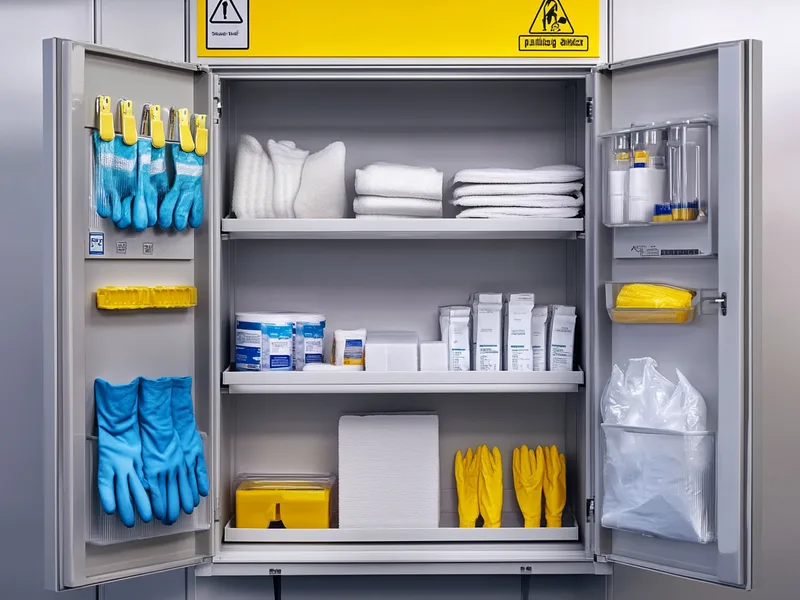
- Spill kits appropriate to the type and volume of liquids on site, positioned near the risk.
- Secondary containment — bunds, drip trays, or containment pallets for stored liquids.
- Drain protection — drain covers or absorbent socks to prevent spills reaching the drainage system.
- Trained staff — people who know where the kits are, how to use them, and when to escalate to emergency services.
- Inspection records — evidence that spill kits are checked regularly and restocked after use.
A well-placed spill station with clear signage, stocked with the right absorbents, and backed by a simple inspection schedule will satisfy the vast majority of regulatory expectations.
Penalties for Non-Compliance
Environmental offences in England and Wales carry unlimited fines and up to five years' imprisonment for the most serious cases. Even minor incidents can result in enforcement notices, formal cautions, and remediation orders that run into tens of thousands of pounds.
Beyond the legal penalties, a pollution incident creates reputational damage, disruption to operations, and the cost of professional cleanup. The investment in a few well-specified spill kits is trivial compared to the cost of getting it wrong.
Getting It Right
Start with your risk assessments and COSHH assessments. Identify what liquids you store and handle, where they are located, and what the worst-case spill scenario looks like. Then specify your spill kits to match — right type, right size, right location. If you need help putting together a compliant spill response setup, contact us and we will walk you through it.